
There's a certain kind of story that only exists because two people happened to be in the same room at the right time. The one Rudy Tutti tells about Elvis is that kind of story, and it starts with a record label that was, at the time, mostly just a guy with an ear.
Two Teenagers, One Label, One Long Ride
Rudy Grayzell was seventeen. Elvis Presley was eighteen. They were introduced through Sam Phillips, the man who turned Sun Records into the launchpad for a whole generation of American music. Phillips had an instinct for the performers who would go on to define the sound of the 1950s, and both young men were early proof that his ear was working.
Rudy became Elvis's opening act for two years. That's not a small piece of history. Opening for a rising star meant playing to rooms that were already half full and half hostile, warming up a crowd that had come for somebody else, and doing it night after night on the road. It's a job that either sharpens a performer fast or sends them home.
Rudy stayed two years, and by his own account, he spent most of that time watching.
What He Actually Learned
Ask Rudy what he took from those two years and he doesn't start with the music. He starts with how Elvis dealt with people.
"He was so talented and had an almost magical charisma, but he was always kind and polite to people," Rudy has said. "He always took the time to listen to people and answer their questions, and I learned so much from him."
That contrast is the part Rudy keeps coming back to, because he had a front-row seat for the other version of fame too. He later worked with Jerry Lee Lewis, whose offstage life was a study in bad nights and short tempers. Rudy, who had been an amateur boxer back in El Paso, Texas, occasionally stepped in to calm things down between Lewis and whatever bar patron had gotten under his skin.
"Elvis was a totally different guy," Rudy says. He describes it as real class and style, with perfect manners, which tells you something about the era and the company Elvis kept. In the middle of all that noise, the most famous man in the room was also the easiest one to talk to.
What Rudy says he learned, in his own words, was how to dress, how to go the extra mile at every performance, and how to demand fair pay from the promoters they worked with. Three things: presentation, effort, and the nerve to stand up for yourself. That's a decent curriculum for a seventeen-year-old on the road.
The Backstage Habit He Took Home
There's one more thing Rudy picked up, and it's the reason this story belongs on a page about a throat drop.
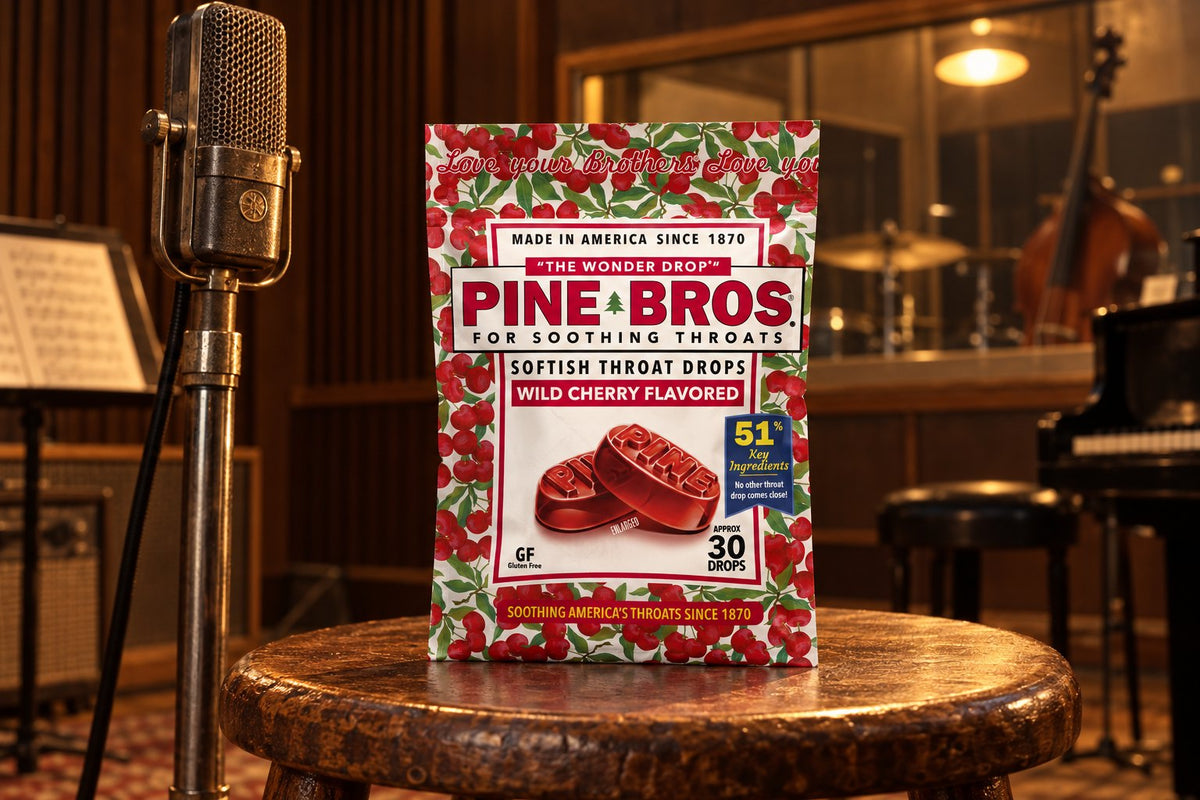
Elvis used to carry a box of Pine Brothers throat drops wherever he went. Not a jar in a dressing room, not a specific bag for specific nights. A box that traveled with him, the way a guitar travels with a musician. He liked the honey and the wild cherry, and he kept them close.
For a working singer in the 1950s, that isn't a random detail. Two shows a night, a smoky room, a microphone that needed volume behind it before amplification got good: a performer's voice was the whole product. A Real Honey or Wild Cherry drop was a practical thing to have on hand, not a novelty.
Rudy noticed and started doing the same thing. As he puts it, he still loves them.
Why That Detail Sticks
Carrying a particular drop isn't a headline. It's a habit. And habits, especially ones people keep across decades and cities and career changes, tell you more about a product than any advertisement does. A famous person can be paid to hold something up for a camera. He can't be paid to keep it in his pocket for the rest of his life.
The reason a habit forms around a drop comes down to how it feels to use one. If it's pleasant, if it doesn't sting or shock your mouth, if the texture is soft and easy to keep going for a while, you reach for it again without thinking. That's the whole design behind the Pine Brothers formula, which has been built on gum acacia, honey, and plant glycerin since 1870. It's a small, daily, unglamorous thing, which is exactly what makes it tell you something.
You can see the texture for yourself in the brand's own words: Not Hard. Not Harsh. Softish..
From a Pocket to the Screen
The story comes full circle in a way that seems almost too tidy. Someone at the Pine Brothers company heard that Rudy Tutti had a connection to the brand going back to the Elvis years, and in 2010 the company hired him to promote Pine Brothers in a series of funny TV and online commercials.
It's a nice arc for a performer whose career has run through rockabilly halls of fame and opening slots for two of the biggest names of the 1950s. The kid who picked up a habit on tour ended up, decades later, telling the story on camera.
What Rudy Says About It Now
Rudy's own summary of those years is less about fame than about luck. He talks about how much it matters, when you're young and on the road and away from home, to have good role models at the exact moment you're still figuring out who you are going to be.
"I say thank you to God and to Elvis every day," he has said. It's a line that sounds simple until you remember he was seventeen when it started.
The Through Line
Elvis at eighteen and Rudy at seventeen, on the same bill and a box of drops between them. The brand has changed its packaging and added flavors since then, and the way people listen to music has changed past recognition. But the thing Rudy picked up is the same thing people pick up today: a soft drop that's easy to keep around.
Elvis died in 1977. Rudy has been telling this story for decades, and the drop he picked up on the road is still on shelves today, made by the same company that eventually put him in front of a camera. That's a long thread running from a backstage habit to a brand still finding new customers in 2026, and it's the kind of thread only a product people actually keep using can produce. A flashy drop stays in the dressing room. A pleasant one travels.
You can browse the full lineup, take the five-minute quiz to find a starting flavor, or use the store finder to locate the nearest shelf. And if you want more of the brand's history instead, the blog has the rest of it.