
World Food Day is Friday, October 16. It is a global day about hunger, agriculture, and the food system, and I am not going to lecture you about food policy, because you have heard that speech. Instead, I want to talk about the people who actually get the food from the kitchen to the table, because October 16 is also, quietly, one of the busiest food-service Tuesdays-to-Fridays of the year, and the crew working the stove is doing it on voices that have been running since the first weekend of fall.
I spent some time around restaurant kitchens in an earlier life, and I have never stopped being struck by one thing: the kitchen is the only room where people shout to be kind. "Heard!" "Corner!" "Behind you!" "Order in!" None of it is anger. It is coordination, safety, and rhythm, shouted over the hood fans and the pans. The kitchen voice is loud, clipped, and constant, and it is the exact voice that nobody in the building protects, because nobody in the building thinks of it as an instrument. It is just how the kitchen sounds.
The Pass Window and the Ticket Voice
The pass window is the heart of the kitchen, and the pass voice is the one that carries the night.
Every ticket that comes off the printer gets read out loud: the modifiers, the allergies, the "no onions extra pickles" that the customer wrote in the notes box and the kitchen has to honor. The line cook at the window reads every one, calls the pickup, and answers every check-back from the servers, a hundred times a night, each time over the roar of the hood and the beep of the timer. It is not a performance voice, it is a working voice, and it is the most important sound in the building, because when the window voice goes, the whole floor goes with it.
Here is the thing about the pass voice that most managers never clock: it is asked to do two opposite jobs. Up, to cut through the noise. Then down, to answer the server's quiet "is my table's food up?" The constant jumping between shout and near-whisper is harder on a voice than either one alone, because the vocal cords never settle into a stable pitch. The cooks who last are not the loudest ones. They are the ones who figured out the two tricks that actually work: close the gap before you speak, and drink something at the window instead of waiting for the break that never comes.
The Heat and the Hoods
Restaurant air is a voice-care problem wearing a chef's coat.
The line runs hot. The hood fans pull the air out, which means the air the cooks do breathe is dry. The heat does the rest. A kitchen on a Friday dinner service is a dry-room workout: warm air, low humidity, and an hour of shouting layered on top. Every restaurant veteran knows what the end of a double sounds like, the rasp that shows up around the time the third ticket spinner fills up, and they blame it on the shift. They are right, but not about why: it is not tiredness, it is the air and the volume.
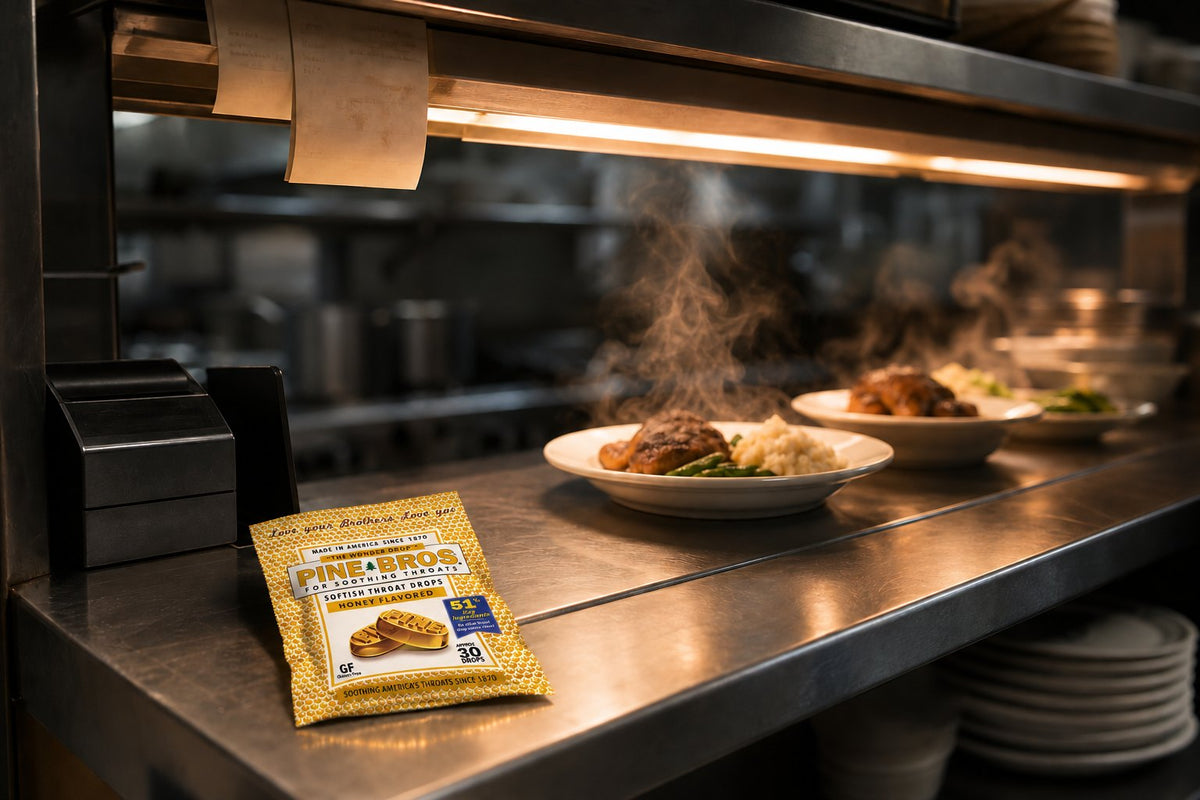
The fix is mundane enough that nobody bothers with it, which is exactly why it works so well. Water at the pass window, not in the back hallway. A bottle that is yours, so it is still there at hour six. And the unhurried cup of something warm on the ten-minute reset, because a kitchen reset without a drink is just a pause. The softish approach to throat comfort is built for exactly this environment: something smooth in the background of a hot, dry, loud room, nothing sharp enough to grab your attention mid-order. The texture post makes the companion point, that the thing you reach for dozens of times a shift has to fit the flow of the work, easy to get to, easy to use, no ceremony.
The Server Voice and the Floor
The front of the house has its own voice, and it is the opposite of the kitchen's.
The server voice is warm, close, and endlessly repeated. It is the "how is everything this evening" that has to sound like a genuine question even when it is the fortieth of the night. It is the wine recommendation, the answer to "what's good?" that has to be honest and specific and fast. It is the dessert menu recitation, from memory, with the voice of someone who is delighted to be telling you about the crème brûlée, though they have described it nine times tonight.
October is a peak month for that voice. Fall menus are new, the specials rotation is running hard, and every table asks follow-ups, because nobody knows the autumn menu yet. The server is the translator between the kitchen shorthand and the table's questions, all night, in a dining room that gets louder as it fills. And the floor is where the voice also has to read the room: loud enough for the table, low enough not to carry to the next one.
Every server has a version of the survival kit, and the good ones keep it in the apron, not the locker: a small pack where the hand lands. Wild Cherry is the flavor a lot of them reach for between tables, familiar enough to grab without thinking, and Real Honey is the favorite for the slow minute at the end of the night, closer to a tea break than anything medicinal. The brand's quiz takes about a minute if you want a sensible starting point, and the full lineup is one scroll away.
The Bakery and the Early Shift
The bakery opens before the restaurant does, and the bakery voice is the earliest voice in the building.
The baker starts talking at a time when most of the city is asleep: to the delivery driver at the door, to the barista testing the espresso machine, to the prep cook rolling out dough. The morning voice is a different instrument from the dinner voice, lower and slower, and it has to stay that way through the breakfast rush, the case restocking, the phone orders for the office down the street. The bakery counter is also a talking station: "how many in the box, do you want the assortment, that one is new and people are loving it." By ten in the morning the baker has talked more than most office workers do in a week, before the lunch shift has even clocked in.
The early shift runs on one rule that sounds too simple to matter: warm up the voice before you warm up the ovens. A few quiet sentences, a sip of water, a minute of not talking after the alarm goes of. The crew that treats the dawn voice gently is the crew that still sounds human at noon.
The Dish Pit, the Last Voice Standing
Everyone forgets the dish pit, and the dish pit has the best story of the night.
The pit is the loudest room in the building, full stop. The sprayer hisses, the racks slam, the plates crash, and the person inside wears ear protection and still has to communicate. So the pit talks with the only channel that works: the hands. The tap on the shoulder, the pointed rack, the thumbs-up through the window. The pit voice is silent on purpose, and it is the most protected voice in the restaurant, by necessity.
There is a lesson there that the whole crew could borrow. The dish pit does not try to out-shout the room; it changes the channel. The rest of the kitchen could do more of that. Walk over instead of shouting down the line. Knock on the window instead of calling across the pass. The voice that is saved by walking twelve feet is the voice that survives the double.
The Family Meal
There is one moment in every restaurant day that is sacred, and it is worth mentioning on World Food Day.
The family meal, the staff dinner before service, is the one time the crew sits down together and the kitchen voices go quiet. It is the only part of the shift where no one is being asked for anything, where the conversation is not a transaction. And here is the part I think about every time: that meal is also voice care. Twenty quiet minutes of low talking, or no talking, while the body eats something warm, resets the instrument faster than any product could, because what the voice actually needs most of the time is the floor time, the minutes it is not being used.
The restaurants that understand this protect the family meal like a contract term. The ones that skip it wonder why everyone sounds wrecked by December.
For the Crew Reading This Before Service
If you are heading into a Friday service tomorrow, the setup is five things and all of them are boring.
One: water at your station, not the locker. Two: a pack where your hand lands, at the pass, in the apron, on the pastry counter. Three: close the gap instead of raising the volume. Four: take the reset, and drink something during it. Five: talk to your crew like the dish pit does, with the hands and the eyes, whenever the room is loud enough that the voice would have to fight it.
The Pine Brothers blog has been writing voice-care pieces for working crews all season, and the kitchen is the room that deserves one of its own. A brand that has been soothing America's throats for over 150 years knows something about working through heat and noise, which is probably why the history page reads the way it does. And if you run a restaurant and want this routine on one page for the kitchen wall, the contact page is the way to ask. Tell them what your pass window sounds like at 7 p.m.
Next time you hear "heard!" through the kitchen door, you will know what it costs the person who said it. World Food Day is about honoring the food system on paper. The crew working the stove honors it every night, with voices that get treated like they are free. They are not.

