
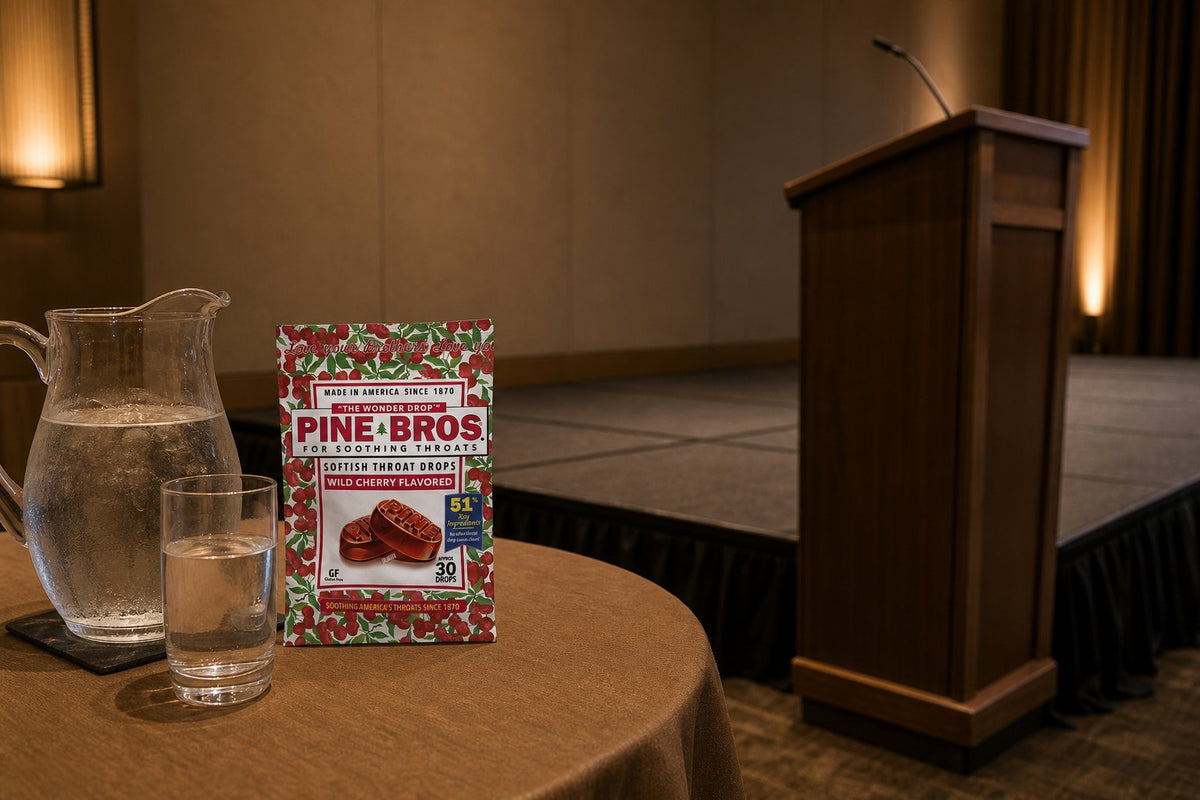
October and November are when the conference calendar goes haywire, and if you have ever spoken at one, you know the specific dread: it is not the stage. The stage is fine. It is everything around the stage.
The keynote is forty-five minutes. The day around it is twelve hours: the early flight, the hotel check-in, the hallway conversations, the panel you agreed to join in June, the exhibit hall where an old colleague finds you and talks for twenty minutes straight, the dinner where you have to be interesting on command. By the time you step off the plane home, you have talked more in two days than in the entire month before it, and almost none of that talking happened in a quiet room.
Conference season is a voice marathon with a stage in the middle. The people who finish it sounding like themselves are not the ones with the best material. They have a system.
The Day-of-Talk Math
Let's lay out the real numbers, because they explain why conferences do what they do to voices.
A typical speaking day runs about fourteen hours, from the 6 a.m. airport shuttle to the 8 p.m. dinner. Of those fourteen hours, a speaker spends maybe one on stage and the rest in some form of talking: briefing the AV tech, catching up with old contacts, answering questions in the hallway, being interviewed for a podcast in a noisy corner, pitching at the reception. That is ten to twelve hours of talking, and here is the part nobody warns you about: hallway talking is harder than stage talking.
On stage you have a microphone, a quiet room, and a script you know cold. In the hallway you are competing with carpet, HVAC, and a hundred other conversations, so you raise your voice without noticing, and raising your voice for hours is what actually wears a voice out. The singers, teachers, and public speakers post on the Pine Brothers blog makes the same point for every working voice: the loudest talking is rarely the most important talking, and the volume you do not notice is the volume that costs you.
The field guide for conference voices starts with one rule: treat the hallway like a stage. Same voice, same pace, same refusal to shout over the room. The room will not mind. The voice will.
The Panel Chair's Job
Panelists get a lot of advice. The panel chair gets none, and the chair has the hardest voice job on the roster.
Asking one good question is easy. Asking a full session of good questions, while watching the clock, while steering a panelist who is three minutes deep into a story about their hometown, while keeping the energy up for a room of people checking email, that is a two-hour shift of constant, alert talking with zero downtime. The chair is the only person who cannot tune out, and the chair's voice is the one that carries the whole room.
The chair also has the thankless job of the wrap-up, summarizing sixty minutes of conversation into four sentences that make the panel sound brilliant. That is a specific voice skill, and it is the most underrated moment of the conference. The best chairs are the ones who keep the wrap-up voice in reserve, which means they are also the ones who sipped water through the whole session instead of waiting for the break.
A small note on panel prep: the softish approach post describes the brand's argument that gentle is the choice that lasts, and there is a desk-level version of that argument for chairs. The chairs who last the season are the ones who show up with a water bottle and a small quiet habit, not the ones who wing it on coffee and adrenaline. Boring is sustainable. Sustainable wins the season.

The Exhibit Hall Voice
The exhibit hall is where conference voices actually disappear, and it is not the booth staff who suffer most. It is everyone who walks the floor.
Booth staff know they will talk all day; they are prepared for it. The attendees are the victims. You walk the floor to network, you stop at a booth, you ask a question, you get the full pitch, you repeat that forty times across two days, and your voice is gone by 2 p.m. on day one. The floor is one enormous open room with a metal ceiling and a thousand conversations, and the ambient noise forces every single person to talk louder than they would anywhere else, all day long.
The exhibit-hall rules are short. First, protect your voice the way you protect your badge: it goes on before you enter the floor. Second, do your loud talking in the first hour, when your voice is fresh and you will not feel the floor yet. Third, take one floor-free hour after lunch, even if it feels wasteful. The people who finish day two are the ones who took the hour on day one.
The Speaker Prep Room
The speaker ready area is the most honest room at any conference, because it is full of people who are all doing the same nervous thing: rehearsing, pacing, running the board, or staring at their notes trying to remember why they agreed to this.
Every speaker's bag should have the same three items, and the first one is not notes. It is water, in reach, not in the bag. A speaker who has to dig for a bottle during a talk loses the room for ten seconds, and ten seconds is an eternity on stage. The second item is a small pack of Real Honey, because it is the quiet option that disappears before you walk out. The third is a printed backup of the talk, because every conference has a story about the projector that died and the speaker who carried on anyway, and the printed backup is the difference between that story being heroic or tragic.
The brand has a whole history page built on the idea of being ready and steady, and it maps perfectly onto the prep room: the speakers who look effortless are the ones who did the boring prep. Same for the voice. The warm-up you do in the prep room, humming scales, sliding down the range, talking yourself through the opening line, is the reason the first five minutes sound easy.
The After-Talk Conversation
Here is the part of conference speaking that the books never cover: the after-talk.
You finish your session, the applause lands, and then you stand in the doorway for forty-five minutes while a line of people tell you about their own work, ask your opinion on their slide deck, and share the story of the conference talk that changed their career. It is lovely, it is flattering, and it is the most voice-damaging forty-five minutes of the day, because you are talking at celebration volume, outdoors or in a corridor, with no microphone and no plan.
The veteran move is to have a place to be: "Let's grab coffee, I need to be at the next session in ten" is the conference speaker's sacred phrase, and it should be deployed liberally. The people who linger until the corridor empties are the people who cannot do the dinner later without croaking. If you want the full voice-care tour of the brand's approach to working voices, the trail starts at that post and runs through every season of the year.
The Virtual Speaker
There is one more conference voice that does not get a badge, and it is the one that travels the least: the virtual speaker.
Every conference now has a handful of talks delivered from home offices and hotel rooms, and the virtual voice has its own quirks. The laptop microphone rewards a steady, close voice and punishes projection, which means the virtual speaker is doing the opposite of the stage speaker: compressing instead of expanding. It is quiet, careful work, and it is deceptively tiring, because the attention never wavers. In a real room you ride the audience's energy. Through a screen you build all of it yourself.
The virtual speaker's rules are the boring ones that always win: water in reach, a pack of Real Honey on the desk where the hand lands, and a two-minute silent reset before the camera goes on. The camera does not need to hear you warm up. It just needs the result. And for the days when you are virtual because you are traveling, the legacy post is a genuinely good read on a plane, because it is the longest version of the argument that steady travel companions beat dramatic ones.
The Dinner Freeze-Out
The conference dinner is a voice event masquerading as a meal.
You are seated with eight people you mostly do not know, in a room with two hundred diners and a live band, and the expectation is conversation with a total stranger at raised volume for two hours. This is also, statistically, where the throat drizzle sets in: talking at volume, in dry hotel air, while drinking wine and skipping water. The dinner is where conference voices go to die, and the death is preventable.
The dinner rules are blunt. Alternate every drink with water, no exceptions, because dry room air plus anything else is how you wake up husky. Sit next to the person you actually want to talk to and let the conversation go deep, because one real conversation beats six shout-level small talks. And if you feel the edge going, the walk-to-the-bathroom technique works: a two-minute break away from the noise, a sip, a breath, and the voice comes back with you.
The Travel Stack
Conference season is really travel season, and travel does its own quiet damage.
Plane air is the driest air most people breathe, and it is the same air on every leg of the trip. Hotel heat is dry. Conference halls are dry. By day two, every voice at the event is running on a moisture deficit, and the deficit is the reason the second day always sounds worse than the first, no matter how the talks went.
The travel stack fixes day two. A pack of Wild Cherry in the laptop bag, not the checked luggage, because the laptop bag is the thing that never leaves you. A bottle filled after security, because the security line is where the first airport water bottle ends up in the trash. And the texture post makes the final point: the smooth, easy choice is what you want when you are exhausted at 10 p.m. in a hotel lobby, not the complicated one. Easy is the feature.
The Week After
The conference ends, the badge comes off, and the voice needs a week, whether you give it one or not.
The pros schedule the post-conference week like a recovery week: no extra speaking, short meetings where possible, and a quiet evening at the start of the week. It feels like laziness, and it is actually maintenance, the same maintenance that gets the season's next conference out of you at full strength. The speakers who do a full season of events are the ones who treat the calendar between events as part of the job, not the time off from it. The 150th anniversary retelling makes the same point about the company: the reason the brand has lasted is that it treats steadiness as the strategy, and the same logic applies to a voice that has to be ready for the next flight, the next panel, the next hallway.
If you are new to the speaking circuit, bookmark the Pine Brothers blog before your first event, because the working-voice archive there is exactly the kind of thing you wish you had read before the first conference, not after. And if you run an event and you want to talk about what speakers actually need in the green room, the contact page is open. Every conference planner we have ever met has an opinion, and most of them are right.
