
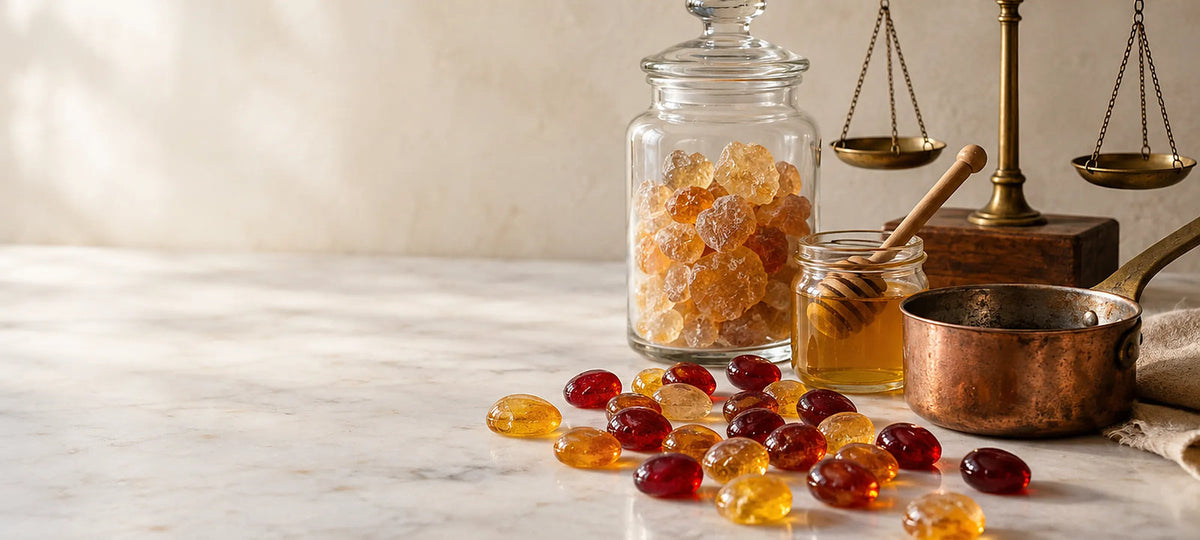
The word "softish" does a lot of work on a Pine Brothers wrapper. It packs the whole idea into one word you won't really find anywhere else in the category.
What "softish" actually means
Softish describes a real difference you can feel in the first two seconds. A standard hard drop is rigid. Bite down and it cracks; leave it in and it dissolves fast, flaring up and then disappearing before you've settled into your seat.
A Pine Brothers drop is pliable, so it gives instead of breaking. It stays whole and softens slowly, and the flavor comes out gradually rather than in one sharp hit. The glycerin base does that, and it has been the core of the formula since the beginning.
If that's a trick, it's an old one. There's no new technology or secret additive, just a texture decision made well over a century ago and never abandoned.
Why texture matters more than people think
Most people shopping for a throat drop read the flavor first and the texture never. That's a mistake, because you keep a drop in your mouth for several minutes and the texture is what you spend that time with. The flavor is more of a backdrop.
With a hard drop you put up with the shell, the crunch and the sharpness because you want the effect. A soft drop has no shell to get through and no cold sting to brace for, so you can just enjoy it. It's a small difference in feel, but it changes whether you reach for a second one.
Over a long day that difference adds up. A teacher on her fourth class, a salesperson on his sixth call, a nurse halfway through a twelve-hour shift: none of them want a jolt. They want something gentle enough to keep using without thinking about it.
The menthol question
Menthol is the default in this category. There's nothing wrong with it, but it's aggressive: a strong, cold sensation that grabs all your attention for a minute or two and then fades. Some people genuinely like that. More of them put up with it because it's what's available.
Pine Brothers skipped the menthol blast, the numbing chill and the hard candy shell. What's left is the soft base with gum acacia, honey, and plant glycerin: honey at 9%, gum acacia at 39%, glycerin at 3%, which together come to 51% of the drop. The story page lays out each ingredient if you want the details.
The brand's own line, Not Hard. Not Harsh. Softish., says all of it in four words. It's the positioning, and it's also a plain description of what the drop does in your mouth.
A texture you can test at home
If you have both kinds in the house, try this. Put a standard hard lozenge on one side of your tongue and a Pine Brothers drop on the other. The hard one spikes fast and is gone. The soft one is still there, steadily releasing flavor, long after the other has finished. It's not subtle.
That's also why people describe a Pine Brothers drop as lasting. No additive is involved; the texture lets it hang around comfortably, so you get more time out of each one.
Five flavors, same soft feel
Once you like the texture, flavor comes down to preference. Wild Cherry is the flagship, bright and zesty. Real Honey is the traditional pick and feels most like the old-fashioned version. Sugar-Free Wild Cherry keeps everything else and drops the sugar. Elderberry is the newest of the bunch, and Licorice has a loyal, slightly obsessive following.
Switch between them and the texture stays the same, which is what you'd expect from a 150-year-old formula.
Made for people who talk all day
The softish texture was built for a specific kind of user: teachers, singers, pastors, coaches, nurses, salespeople, podcasters, flight attendants, parents who spend their day being interrupted mid-sentence, and anyone else whose voice is the tool.
The brand's current line, For Throats That Have Work to Do, is aimed straight at that crowd, and the not hard, not harsh piece goes a little further into why texture is the whole reason the product exists.
The first five minutes
A photo can't show you this part. With a hard drop, the first five minutes are a spike and a decline: a sharp burst, a fast fade, then a shell that goes from hard to gone. A Pine Brothers drop runs the other way. It starts quiet, then settles into a slow, steady release that's still going well past the point where the hard drop finished.
That curve is most of the product's personality. You don't brace for it, and you don't have to time it around anything. It just sits there softening, doing the small pleasant job a drop is supposed to do, for as long as you want it around.
What softish isn't
Softish gets misread. It doesn't mean jelly, and the drop isn't sticky or gummy or prone to melting into a mess. It holds its shape, just with some give to it. Pick one up and it has form; press on it and it yields instead of cracking. In your mouth it softens gradually, the way a good caramel does, without ever turning into a puddle.
That balance is hard to hit, which is why the formula behind it hasn't been widely copied. Too soft and the drop collapses; too hard and you're back to a standard lozenge. The glycerin base sits in the middle, and it took a long time to get there. Six or seven generations of customers have since confirmed the choice was right.
The standout is the simplicity
Most products that "stand out" do it by adding something: more flavor, more punch, more ingredients on the label. Pine Brothers stood out by subtracting the menthol, the hard shell and the harshness, which leaves glycerin, gum acacia, honey, and a texture you can only describe as softish.
If you've been buying hard drops out of habit, the shop page has the lineup and the five-minute quiz will tell you where to start. Sometimes the thing that stands out is the thing that stayed simple.