
Every year, the same email goes around the hospital in late September. It has a subject line like "Flu Season Preparedness" or "Respiratory Illness Update," and it tells you to wash your hands, get your flu shot, and mind your PPE. It is a good email. It is useful and it is true.
But there is a sentence missing from that email, the sentence nobody sends: your voice is about to work harder than it has all year, and nobody on the unit has a plan for that.
October is when the volume picks up. More patients, more call lights, more questions, more repeating yourself through a mask and across a hallway. The shift gets longer in the ways that matter. And the voice, which is the one tool a nurse cannot clock out, quietly becomes the thing that carries the whole season.
The Mask Changes the Calculation
The mask does not just cover the face. It changes the voice, and it changes the person using it.
First, the obvious: sound has to travel through fabric, so the first instinct is to push more volume to get the same result. Second, the less obvious: the mask traps warm, humid air close to the mouth, which sounds like it would help but actually changes the way the throat feels over hours of talking. The voice starts the shift one way and ends it another, and the difference builds across the week, not the day.
Third, and this is the one nurses talk about among themselves: a mask makes you repeat yourself. Patients lip-read more when they cannot see your full face, and they ask twice as often. "Sorry, again?" becomes the loop of the shift. Every repeat is a fresh load on the same voice, and a twelve-hour shift in October has more repeats than a twelve-hour shift in June, because there are more patients, more noise, and more people who cannot hear you through the fabric.
The Call Light Isn't the Conversation
Here is the thing about nursing work that the schedule never shows: the loudest conversations are not with patients. They are with the unit itself. The report at shift change, given over the noise of a station that never goes quiet. The update to the charge nurse, shouted halfway down the hall because nobody has time to walk. The family at the desk, asking the same question in different words while you hold a phone in one hand and a chart in the other.
That is where the October voice wears down fastest, not at the bedside, but in the hallways and at the station, where nobody thinks of it as voice work because nobody is singing. It is voice work all the same, and it is constant.
The First Time You Sound Different to Yourself
There is a moment in October when nurses notice the change. It is usually not dramatic. You answer the phone and hear yourself from the outside for a second, and you think: that does not sound like me. Or you finish a long report and your voice feels smaller than it did at check-in, the way a muscle feels after a long set.
That moment is the signal, not the problem. The problem is what happens next, which is that almost everyone pushes through it. There is no space in a hospital day to stop and reset a voice, so the pushing becomes the default, and the default becomes the season.
The Pocket Strategy
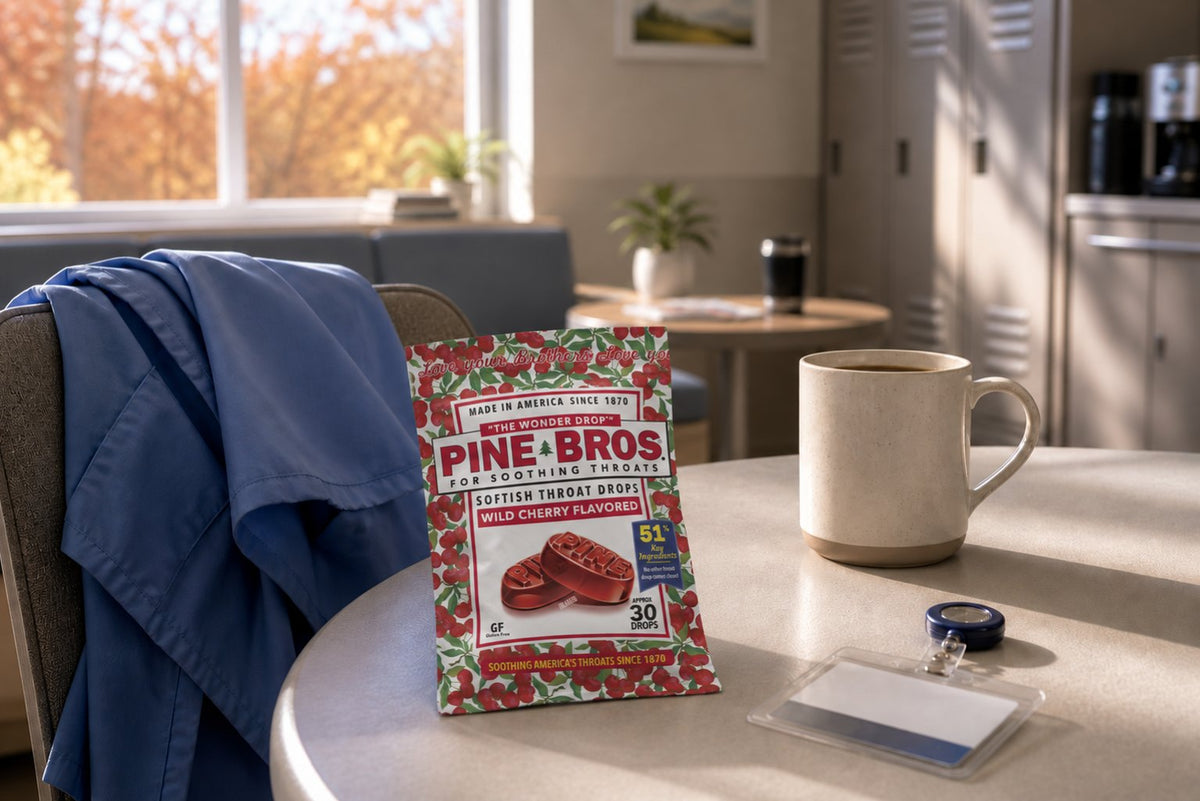
Nurses run the hospital on pockets. Pens, scissors, tape, a phone, a charger, a granola bar, the things that need to be within one reach at all times. The softish strategy for October is to add two things to the pocket system: one pack of drops and the habit of a single sip of water at every charting break.
The brand's answer to all of this is a comfortable, gentle drop rather than a harsh one, which is exactly the right energy for work where you do not have time to feel like something is "working" by stinging. The softish explanation post lays out the idea: the texture is the whole point, and the texture of softish is easy to keep using. Real Honey and Wild Cherry tend to be the flavors that live in scrub pockets, according to the folks who keep our shop interesting.

The Charting Break Reset
Charting breaks are the only pockets of quiet in a hospital shift, and they are usually spent staring at a screen, which means the voice gets no part of the break.
Turn one charting break into a voice reset. It takes ninety seconds: sit down, breathe out slowly once with the shoulders down, take a sip of water, hum one low note for five seconds. That is not a wellness program. It is the same thing a runner does between intervals, applied to the one muscle group the shift actually uses hardest.
The nurses who build this into their charting routine are not doing it out of zen discipline. They are doing it because a voice that survives the shift also survives the month, and the month is the unit of time that actually matters in October.
The Mask Voice, After Hours
There is a specific October phenomenon that deserves its own name, so let's give it one: the after-hours mask voice. You finish the shift, take the mask off in the car, and talk to your family in a voice that is suddenly hoarser than it was at handoff. The mask came off, the voice did not come back.
That gap, between the end of the shift and the return of an easy voice, is longer in October than in any other month, because the load is higher and the break is shorter. The after-shift ritual matters: water before you leave, a quiet ride home instead of a loud one if you can manage it, and the car pack in the glove box for the commute, so the drive is doing something for the voice instead of nothing.
What the Overnight Does Differently
Night shift has its own October math. The building is quieter, which sounds easier, and it is, except the quiet means every voice carries further and the mask does more work because there are fewer other sounds to mask the muffling. Plus the overnight voice is starting from a body that has been awake through its usual rest hours, which is its own kind of dry.
The overnight pocket system is the same as the day one, with one change: keep the water warmer. A warm sip lands differently on a voice that has been working in cool hospital air all night, and the routine of it, warm water, one sip, one quiet section of hallway, is easier to keep in the small hours than any elaborate plan.
The Unit-Wide Habit
Here is the part that is bigger than any one person: October voice care works better when it is a unit thing, not a personal thing. The charge nurse who puts a water station near the station, the supply closet with a small bowl of drops next to the tape and the pens, the shift report that includes a two-second "voices ok?" check, all of those turn a personal routine into a team default.
Teams protect voices for the same reason they protect backs: because the work does not happen without them. The unit that treats its voices like equipment, checkable and maintainable, is the unit where the December voices still sound human.
If you are the person who can start that habit on your unit, start with the smallest version: one bowl, one drawer, one supply run. The brand's own history is built the same way, one softish drop at a time since 1870, and the legacy story is a good fourteen minutes of reading for the slow part of a night shift.
The December Checkpoint
October routines exist so December does not surprise you. By December, the unit is full, the shifts are long, the holidays have taken their usual toll on everyone's schedule, and the voices that got ignored in October are the ones that give out first when the pressure spikes.
So set a checkpoint now, in the first week of October: how does your voice feel at the end of a shift, honestly? Write it down or just remember it. That is the baseline. The whole plan, pocket drops, charting resets, warm water, the car pack, is just the machinery for keeping that end-of-shift feeling from getting worse between now and the holidays.
There is also the larger idea that a softish throat comfort habit is for exactly these long stretches of work, and the brand's blog post on the softish versus the harsh is the best version of that argument we have. The short summary: you should not have to feel a sting to believe something is working.
The Shift Nobody Reads About
A final note for the nurses reading this: the quiet work, the voices nobody writes about, the repeated patient names and the hallway updates and the family questions at the desk, that work is the work. It deserves the same five minutes of care as any warm-up or cool-down in any other profession.
The Pine Brothers causes page talks about the brand's relationship with the communities that use it, and it is a small thing, but it is worth knowing that the people behind the packs built 150 years of throat comfort for exactly the workers who never stop long enough to think about their voices: the teachers, the nurses, the ones who talk all day for other people.
So this October, when the email goes out about flu season, add your own subject line: voice season. Hands get washed, shots get scheduled, and the voice gets a pocket system, a charting reset, and a car pack. Same season, same plan, all the way through.

The Patient-Facing Repeats
There is a whole subcategory of October nursing work that deserves its own paragraph: the repeat. Not the medical repeat, the social one. The patient who asks the same question four times, the family member who needs the same reassurance in three different wordings, the cognitive repeat that comes with being older, tired, scared, or all three.
The repeat is not the patient's fault, and it is not the nurse's fault. It is the season. And because it is the season, it can be planned for: the voice that answers the fifth question the same way it answered the first is the voice that survives the shift.
The Break-Room Bowl
The break room is the unsung hero of the October unit, and the bowl of drops on the break-room table is the least official and most-used piece of equipment on the floor. One bowl, set by the coffee, refilled by whoever finishes their shift first, and suddenly the voice ritual is not a personal habit. It is the room's habit, and rooms hold together better than individuals.
It saves the argument about which flavor, which is the second-best gift the break-room bowl ever gives.
The Week That Has Two Mondays
October has a scheduling feature that kills voices quietly: the week with a day off in the middle, usually a half day for training or a holiday. The body treats the day off as a reset, the voice treats it as a break, and the second half of the week arrives carrying a Monday voice.
The two-Monday week is the one week where the baseline matters more than the plan. Keep the water and the pocket pack through the day off, so the second half does not double-charge the voice.
The Morning Report Voice
The morning report is the first voice event of every shift, and it is the most under-rehearsed, because nobody thinks of report as a performance. It is a delivery, and it is the exact length and volume the rest of the shift will use: sustained, structured, and audible over the station's noise.
Give report the same one-minute reset the bedside gets: a sip of water, one exhale with the shoulders down, the first sentence at a comfortable pitch. It is the smallest change in this whole piece and it lands on the part of the day that sets the tone for everything after it.
The softish approach is built around the same idea, comfort that lives in the routine rather than the rescue, and the legacy post tells the 150-year version of the theme. The routine wins because it runs the whole season.
Read more voice-care content on the Pine Brothers blog, and see the brand's own story on Pine Brothers' history. For bulk orders and partner questions, reach out through Pine Brothers contact.