
Election Day 2026 is Tuesday, November 3, and if you've never worked a polling place, the job sounds like sitting down all day. A poll worker walks in before six in the morning, swears in, sets up the tables, and then talks to several hundred people in a row, with a handful of breaks, until the last ballot is counted and the hall is packed up. It's the longest single talking shift in American civic life, and almost nobody prepares for the voice part of it.
I started thinking about the poll-worker voice after my first shift, which I mostly remember as a blur of names, addresses, sample ballots, and the same three sentences repeated until they stopped sounding like language. By four in the afternoon I was croaking at people, which is a bad thing to do when the person in front of you is nervous about voting for the first time.
Here's what the day asks of a voice, and what makes it survivable.
The four sentences you will say eight hundred times
Every polling place runs on a small set of lines, and the lines never change.
"Good morning, are you here to vote?" "I will need your name and address." "Please sign here, this is your sample ballot, take it with you to the booth." "I scan it right over there, thank you and have a good one." That's the job. The greeter says the first and the last. The check-in clerk says the middle two a thousand times, and the ballot judge explains the scanner to every single person as if they're the first, which they are, because it's their first time.
The trouble with repeating a short script for fourteen hours is that the voice has no variety to rest on. Actors are warned about this in long-running shows: the same line delivered the same way, hour after hour, is harder on the instrument than a wide-ranging part, because the same muscles do the same thing with no variation. A poll worker is doing a one-person show with a four-line script and an audience that changes every ninety seconds, all day, in a room with bad acoustics and a door that keeps opening.
The veterans all find the fix eventually: vary the delivery on purpose. Same words, different rhythm. Say one greeting slowly, and give the next one with a nod instead of the full sentence. You aren't putting on a show; it just keeps one set of muscles from doing all the work.
The hall acoustics nobody planned for
A polling place is nearly always a room built for something else: a church basement, a school gym, a community hall, a library meeting room, a firehouse bay. None of them were designed for a dozen simultaneous conversations, and all of them are hard-surfaced, so every voice in the room bounces off the walls and lands in everyone else's ears.
That's why the poll-worker voice works harder than it looks. Besides the person in front of you, you're talking over the voter two tables over, the scanner's beep, the door, and the queue that has opinions about how long the queue is. In a hard room the voice automatically goes louder to be understood, the hall gets louder to compensate, and by noon everyone is at a volume that would be unthinkable in a normal job.
Households that manage quiet talking in loud rooms know the trick, and it's the one thing I'd tell every first-time poll worker: get closer before you get louder. Lean toward the voter. If the voter is hard of hearing, ask them once whether they'd prefer the written instruction card, because the card costs your voice nothing and works fine. Every polling place already has the instructions in writing, and most workers never use them because reading them out loud has become a habit.
The cold, early start
The poll-worker shift also starts in the dark.
Doors open at six in most places, which means setup at five, which means walking into a cold building in the dark in the first cold week of November. The room warms up slowly, because nobody turns the heat on for a room that's empty at five in the morning, and the first hour goes to standing at a table in a cold hall making small talk with colleagues instead of using the voice at all.
That first hour is the free hour, and it's almost always wasted. It's the only quiet talking period of the day. A worker who spends it on a warm drink and a low-volume conversation, instead of shouting across the hall during setup, starts the day with a voice that still has something in reserve at three o'clock.
The cold matters more than people think, though not in a dramatic way. Cold air, and the dry air from the heat that kicks on later, are the same problem in two forms: the voice doing work without moisture. Water at the table. It sounds too small to mention in a piece about a fourteen-hour shift, and it is the single highest-value thing you can put within arm's reach.
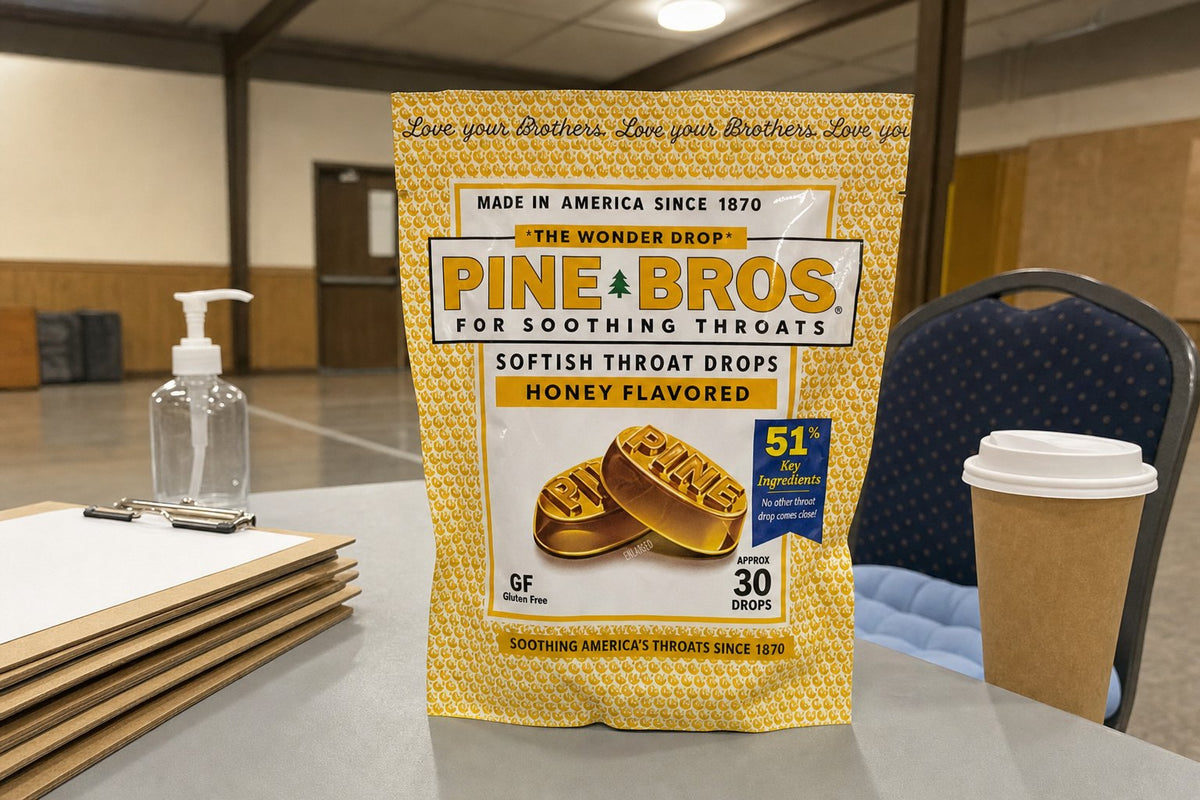
If you want the small object that solves the "I cannot leave the table" problem, the Real Honey pouch is what ends up in the tote bag with the clipboards, simply because it takes one hand, makes no wrapper noise, and doesn't require you to step away from a voter mid-sentence. The Wild Cherry is the other one people reach for, and if you've never picked a flavor, the brand's quiz settles it in about a minute. The full lineup is one page.
The last two hours
Every poll worker knows the day has two halves, and they're nothing alike.
The morning is steady, with a rush at seven and another at nine. The middle of the day is quiet enough that some places let workers rotate to a break. Then somewhere around four in the afternoon, it all changes. People get off work and come straight to the polls. The queue forms, the room fills, and the last two hours are the busiest of the day, right when the voice has been in use for ten hours.
Nobody warns you about this part. The veteran poll workers are the ones who spent the morning twenty percent quieter than they wanted to, so the five o'clock rush got the voice they had left.
If you're working a shift this year, build the day backwards from five o'clock. Decide what the last two hours need, and protect that in the morning. Rotate out for a real break during the midday lull, even if the room doesn't seem to need it, because the room will need it later.
The evening count
Then the doors close, and the work isn't done.
The count is a different kind of voice shift: close, quiet, exacting. You read ballot numbers out loud, confirm tallies with the other inspectors, and report the totals by phone to the county. After a day of saying the same four sentences, the count asks for careful, deliberate, low-volume speech, which is a very different demand on the same tired instrument.
Two things help. First, save a bottle of water for the count, because nobody remembers to drink during it. Second, alternate who reads. A pair of inspectors who tag-team the call-and-response part of the count will finish with less wear than one person reading it all. It's the same rest-and-rotation idea that runs through the singers, teachers, and public speakers post, where the instrument recovers between efforts rather than during them.
The volunteer crew and the quiet table
If you're staffing a polling place this year, the crew matters as much as the room. On a shift that works, the workers look after each other without being asked. Somebody brings water for the table. Somebody takes the greeter slot for twenty minutes so the check-in clerk can stop talking entirely. Somebody writes the four sentences on a card so the newest volunteer can put their voice away every few minutes and just point.
The card is the best trick in the building and it costs one sheet of paper. A printed sheet on the table, facing the voter, that says where to sign, where to scan, and what to take with them removes hundreds of repetitions of the same sentence from the day. Speed is good at a polling place, and speed that doesn't cost anyone their voice is better.
If you're running the site, this is the difference between a crew that sounds fine at the count and a crew that's croaking at the door. It's one card and one bottle per table, and almost nobody does it, which is why it's worth writing down.
The softish approach to throat comfort is built for long days like this: something smooth that sits in the background of a loud room without pulling attention. The texture post explains why the feel of the thing matters so much when you use it a dozen times in a shift.
For anyone voting on November 3
There's one thing a voter can do that helps the whole room: have your name and address ready, in your head or on paper, before you reach the table.
It's a queue tip, and it's also a voice tip for the person across the table. Every voter who arrives prepared saves the clerk a repetition, and the clerk doesn't get a break between voters. Four hundred prepared voters make a lighter day than four hundred who are doing it for the first time in the dark, and I say that with all the sympathy in the world for the first-timers, because the first time is the whole reason the polling place exists.
The Pine Brothers blog has been writing working-voice pieces all fall, and the poll workers earned one, because no other job in the country has a person talking to their entire neighborhood in a single day. A brand that has been soothing America's throats for over 150 years has seen a few of these Tuesdays, and the history page says it better than I can here.
Next time you're standing in a line that isn't moving fast enough, look at the person at the front. They've been saying the same four sentences since five in the morning, and they'll still say yours properly. If you want the one-page version of this routine for your local site, ask for it through the contact page.

