
Fall playoff season is the best month of the year to be a spectator, and the worst month of the year to be the person in the striped shirt.
By late October, every sport that plays in the fall is in its win-or-go-home stretch. Soccer districts, volleyball sectionals, football playoffs, field hockey, the last cross-country meets. The games get tighter, the crowds get bigger, the sidelines get louder, and the official in the middle of it is doing the only job on the field that cannot be substituted, cannot be rested, and cannot be done at low volume. I have officiated enough fall games to know exactly what the Tuesday after a playoff weekend feels like, and it is not a sore knee. It is the voice.
Here is what the job actually asks for in October, and what actually gets officials through it.
The Job Nobody Thinks Is a Voice Job
People hear "referee" and picture a whistle. The whistle is maybe a fifth of the communication, and on the sports where the whistle carries everything, like soccer, it is even less, because a whistle cannot explain.
The rest is voice. You are talking constantly, to players, to coaches, to your partner on the other side of the field, to the scorekeeper, to the captains at the coin toss. "Play on." "Blue ball." "Check the runner." "That is a hold, number twelve, watch your hands." "Clock, please." "Two minutes." It is a running commentary spoken at a volume that has to carry across a field, in front of an audience that is reacting to every call, for the length of the game plus the warm-up plus the walk to the car.
And unlike almost every other job with a voice, the official's voice is a performance under pressure with no rehearsal. The one sentence you say all season, the one that explains a call to a coach who disagrees, is the sentence that has to come out clear and calm at the exact moment your heart rate is highest. That is the real voice demand of officiating, and nobody trains for it.
The Crowd and the Volume Trap
The single hardest thing about playoff officiating is the noise, and it is not the noise you think.
It is not that the crowd is loud in a way that stops you from talking. It is that the crowd is loud in a way that makes you talk louder than you should, and you do not notice until the game is over. A playoff crowd is closer to the field, louder per person, and far more opinionated than a regular-season crowd, because the stakes are higher and everybody in the bleachers has become an expert on a rule they read once in 2011.
So the official does the obvious thing and raises their volume to cut through it. Then the crowd, hearing the official, gets louder. Then the official gets louder again. By the second half of a tight playoff game, the official is projecting at a level that has nothing to do with what the game actually requires, and every one of those extra decibels comes out of the same two small muscles that have been working since the coin toss.
The veterans beat this by changing channels instead of raising volume. Get closer to the player you are talking to. Use the whistle for the parts the whistle does better, which is most of the stop-and-go. Save the voice for the parts that genuinely need language, the explanations, the warnings, the calm-down moments. And hold the whistle away from your own ear, because the sharp blast next to your head all afternoon is its own small tax on everything above your shoulders.
The Cold Field and the Late Kick
Two more things make October different, and both are physical.
The first is the temperature. Playoff season is the first genuinely cold month of the sport's calendar. Games run in the evening, the field is colder than the sideline, and the wind is moving. Cold air does not damage a voice on its own, but it does make the work feel harder, and it makes the automatic project louder, because everything in the cold seems farther away than it is. Officials who dress for the bench instead of the field are the officials who spend the second half hunched and shouting.
The second is the late kick. Playoff scheduling pushes games into the evening, and evening games in late October mean the temperature drops through the game rather than holding steady. The voice that felt fine at the opening whistle is working in air that is ten degrees colder by the final minute. That is not a dramatic problem and it is a real one, and the answer is the boring one. Water at the bench, or on the lanyard, or in the bag you actually carry to the field. Not in the car.
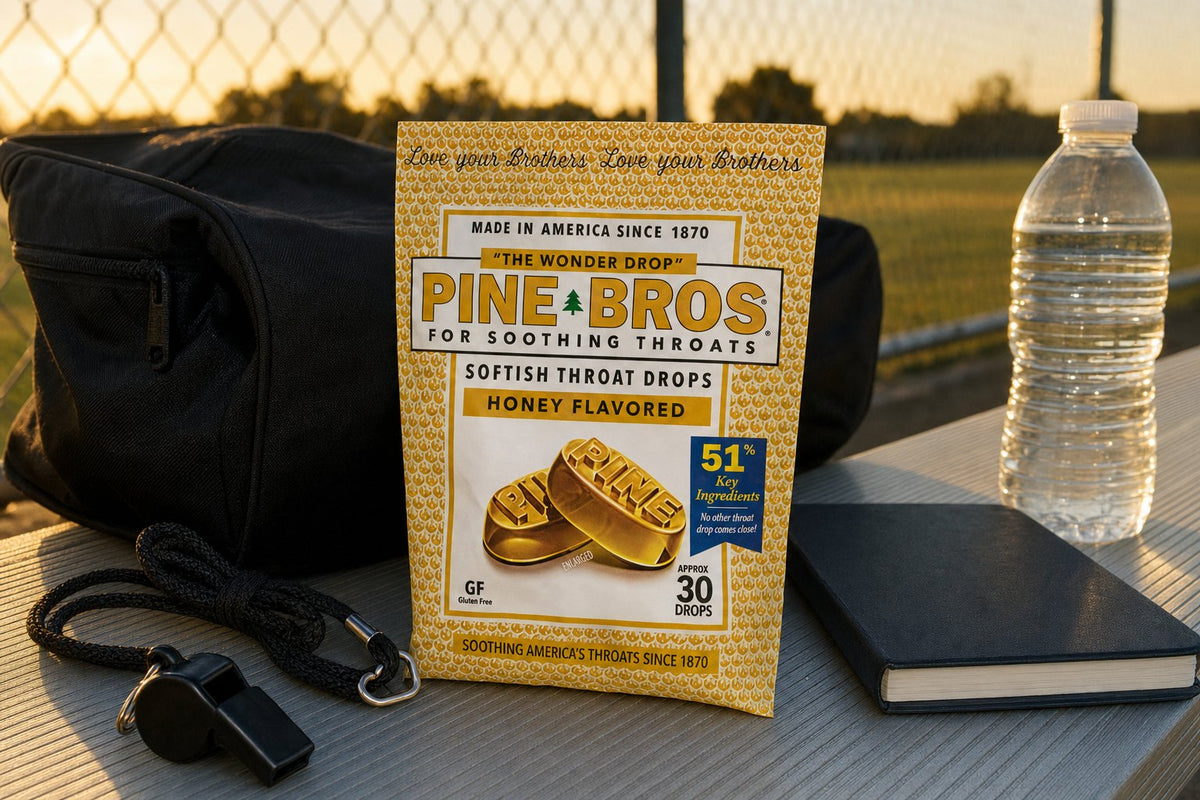
If you want one small thing that lives in the referee bag without taking up space or making noise, the Real Honey pouch is what a lot of officials keep in the side pocket next to the spare whistle, because it is one hand, it does not need a break to use, and it survives being dropped in a bag for a month. The Wild Cherry is the other common pick. If you have never chosen, the brand's quiz does it in about a minute, and the full lineup is one page.
The Coach Conversation
This is the part of officiating that uses the voice hardest, and it is the part nobody trains.
A contentious call in a playoff game produces a coach at the sideline with a question, and the answer has to be delivered in a way that closes the conversation instead of opening it. That means a low, steady, unhurried voice, a short sentence, and no rising tone at the end. It is exactly the opposite of the voice the official has been using for the previous twenty minutes, which was loud and across a field.
The jump from projecting across a field to speaking quietly and firmly three feet from a coach is harder on the voice than either one alone, in the same way that a singer who alternates between a belt and a whisper all night pays for it the next morning. The officials who handle it well do two things. They walk to the coach instead of calling to them, which lets the voice drop to a normal level before the sentence starts. And they keep the sentence short, because a short calm sentence is easier on the voice and easier to end.
I have never met an official who regretted walking twenty yards to deliver a sentence quietly. I have met plenty who regretted the version that started as a shout from the far touchline.
The Playoff Weekend Stack
Here is what makes late October different from the rest of the season: the games come in piles.
Regular season is one or two games a week. Playoff season is a tournament: three games on a Saturday, possibly a Sunday, possibly a midweek game rescheduled from a rain-out. Officers who work a full tournament weekend are doing more talking in forty-eight hours than they did in the previous two weeks combined, on cold fields, with crowds at maximum, then driving home and doing it again the next morning.
The officials who come out of a playoff weekend without a voice problem are not the ones with the loudest whistles. They are the ones who treat the games as a schedule. Water between games, not during them. A real break at the concession stand, sitting down, not talking for ten minutes. And the most important and least popular item on the list: the drive home is a quiet drive. The combination of cold air, crowd volume, and then an hour of post-game phone calls in a warm car is what actually finishes a voice off.
The singers, teachers, and public speakers post on the Pine Brothers blog makes the point that a working voice recovers between efforts, not during them, and a playoff weekend is a series of efforts with almost no recovery time built in. Build the recovery in yourself, because the tournament schedule will not do it for you.
The Young Officials and the First Playoff
If you are new to officiating this year, the playoff month teaches you a lesson the regular season hides.
Regular season games are forgiving. The crowds are smaller, the stakes are lower, and you can get through a game on adrenaline and a raised voice. Playoff games are not forgiving, because they are longer, louder, colder, and much more likely to include a coach who wants an explanation. The first playoff weekend is when a new official discovers that the voice is part of the equipment, and that it needs the same care as the cards and the whistle in the bag.
The advice I would give a first-year official in late October is short. Bring water to the field, not the car. Warm up your voice on the drive like you warm up your legs at the field. Take the whistle for the parts the whistle handles, and save your voice for the parts that need words. And when a coach arrives, walk to them, drop your volume, and use one short sentence.
The Parent on the Touchline, and the Coach
Two more voices are working the same field, and they are both doing it on the fly.
The coach is doing a full season's worth of talking in ninety minutes: instructions, encouragement, correction, the substitutions, the halftime talk, and the conversation with the official that coaches never enjoy. Playoff coaching voice is the loudest voice on the field and the one that has to switch registers fastest, from a shout across the field to a quiet word to a player at the bench.
The parent on the touchline is doing the thing every parent says they will not do and then does anyway: coaching from the sideline at full volume for the length of the game, in the cold, standing, holding a coffee that went cold in the first ten minutes. Nothing about that is a professional voice shift, and after a playoff weekend with three games in it, the touchline parent is often the hoarsest person in the car.
The fix for both is the same and it is not really about the throat. Pick the moments. The game does not need you talking for seventy minutes. It needs you at the ten moments that matter, and those moments will sound better if the voice has something in reserve when they arrive.
After the Final Whistle
Playoff season ends the same way every year, with a whistle, a handshake line, and a drive home in the dark that now starts before five in the evening, because the clocks will have changed by then. The officials who spent October looking after their voices are the ones who show up to the winter season in good shape, and the ones who did not are the ones who start November wondering why everything above their collarbones hurts.
The softish approach to throat comfort is built for exactly this kind of work: something smooth that sits in the background of a cold, loud, outdoor assignment without pulling your attention off the field. The texture post explains why the feel matters more than anything else when you use it a dozen times in a shift.
The Pine Brothers blog has spent the fall writing pieces for working voices, and the officials deserved one, because there is no other job in sport that talks this much and gets this little sympathy for it. A brand that has been soothing America's throats for over 150 years has watched a lot of Octobers end on a cold field, and the history page tells that story better than I can.
If your officials' association wants the playoff-weekend routine on one page for the bag, the contact page is the way to ask. The crowd will still disagree with the call, and the coach will still walk out to the touchline. At least the person in the middle can finish the weekend with a voice.

